
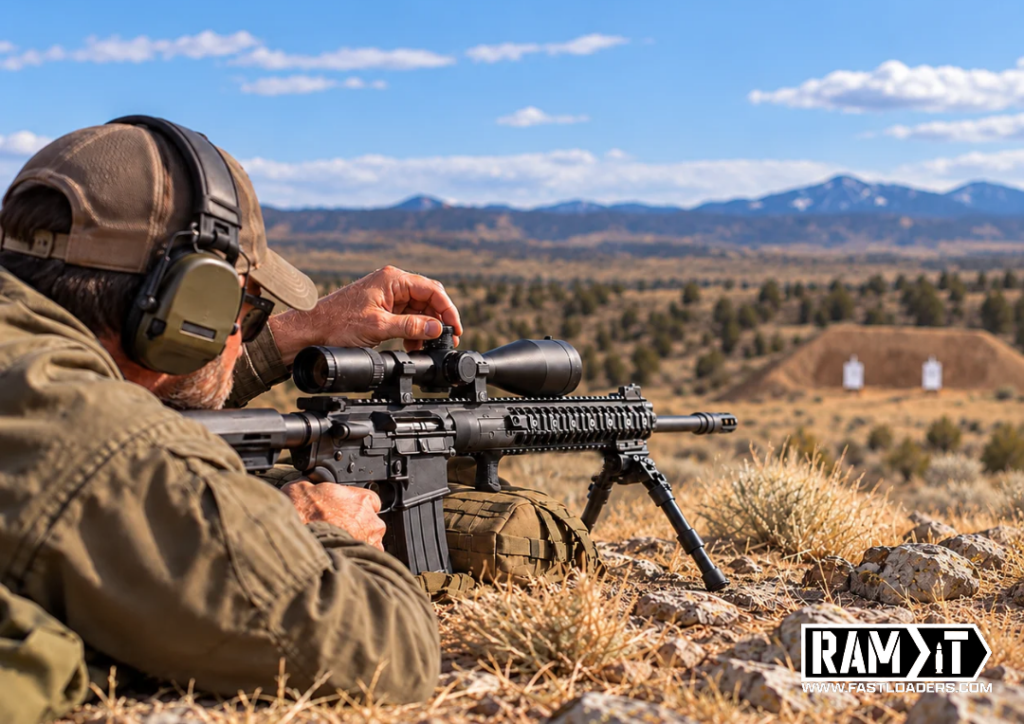
You fire a group, walk downrange, and the impacts are not exactly where you expected them to be.
The temptation is immediate: reach for the turret and start making corrections.
Sometimes that is exactly what you should do. Other times, adjusting your optic after every questionable group is one of the fastest ways to turn a properly zeroed rifle into one that is constantly being chased around the target.
A rifle zero should be based on repeatable evidence, not a single group or one unexplained shot. Knowing the difference between a genuine zero shift and normal variation can save ammunition, range time, and a lot of unnecessary adjustment.
What Does It Mean for a Rifle to Be Zeroed?
A rifle is zeroed when the relationship between the optic’s point of aim and the bullet’s point of impact has been deliberately established at a known distance.
That does not mean every bullet will land in exactly the same spot.
Even with a properly zeroed rifle, groups have size. Ammunition varies. Wind changes. Shooting positions change. The shooter introduces movement. Barrel temperature and environmental conditions can also influence where rounds land.
The important question is not whether every impact is perfectly centered.
The question is whether the center of your repeatable groups is where it should be.
One Bad Group Does Not Automatically Mean Your Zero Moved
This is where shooters can get themselves into trouble.
Suppose a rifle was previously confirmed at 100 yards. You fire a three-shot group and it lands an inch left of where you expected.
That is information, but it is not necessarily proof that the scope needs adjustment.
With a small group, one imperfect shot can move the apparent center significantly. A minor change in shooting position, shoulder pressure, trigger control, wind, or ammunition can also affect the result.
If you immediately dial the optic based on that group, the next group may land somewhere else. Adjust again, and before long you are chasing individual groups rather than maintaining a confirmed zero.
Look for a Pattern Before Making a Correction
A legitimate zero change should normally show itself through repeatable results.
If multiple properly fired groups continue to center in approximately the same incorrect location, then an adjustment becomes much easier to justify.
For example, if several groups consistently center about 1.5 inches right of your intended point of impact, you have a pattern.
If one group is right, the next is centered, and another is slightly left, the optic may not be the problem at all.
Consistency matters more than any single target.
Before touching the turrets, ask whether the deviation is repeatable.
Group Size Matters
The smaller the sample, the easier it is to misread what the rifle is actually doing.
Three-shot groups are useful for many purposes, but they provide relatively little information. A single outlying round can dramatically change the apparent center of the group.
Larger groups generally provide a clearer picture of the rifle and ammunition combination.
That does not mean every zero confirmation requires an enormous string of fire. It means you should be cautious about making precise optic adjustments based on very limited evidence.
When something looks wrong, another group is often more useful than another click of the turret.
Eliminate the Obvious Variables
Before deciding that your rifle has lost zero, look at what changed.
Ammunition
Changing ammunition can change point of impact.
Different bullet weights, velocities, bullet designs, manufacturers, and even different loads from the same manufacturer may not shoot to exactly the same point of impact.
If your rifle was zeroed with one load and you switch to another, a shift does not necessarily indicate a problem with the optic.
Whenever practical, confirm zero with the ammunition you actually intend to use.
Shooting Position
A rifle fired from a stable bench position may not produce exactly the same results when fired prone, from a barricade, from a bag, or from another field position.
Changes in support and body position can alter how the shooter interacts with the rifle.
If a questionable group was fired from a less stable position, confirm the result under controlled conditions before adjusting the optic.
Wind
Horizontal movement on the target does not automatically mean your windage setting is wrong.
At longer distances especially, wind can move bullets enough to make an otherwise correct zero appear questionable.
Before making a permanent adjustment, consider whether the conditions changed between groups.
Shooter Input
No shooter is completely removed from the equation.
Trigger press, sight alignment, head position, shoulder pressure, grip, follow-through, and general stability all contribute to the final result.
This does not mean blaming every unexplained impact on the shooter. It means confirming the problem before assuming the equipment is responsible.
When You Should Suspect a Real Zero Shift
There are situations where checking the rifle more closely is warranted.
A rifle that previously produced consistent results but suddenly begins placing repeated groups in a different location deserves investigation.
Possible causes can include:
- A loose optic mount
- Loose scope rings
- Hardware that has shifted
- An optic that has taken a significant impact
- Changes to the rifle or mounting system
- A substantial ammunition change
- Mechanical problems with the optic
- Components that were removed and reinstalled
If the point of impact continues moving unpredictably even under controlled conditions, simply adjusting the turrets may not solve the underlying problem.
Check the equipment first.
A loose mounting system cannot be fixed by repeatedly changing windage and elevation.
Confirm Before You Correct
A simple confirmation process can prevent most unnecessary adjustments.
If a group appears to indicate a zero shift:
- Do not immediately adjust the optic.
- Check the rifle, optic, and mounting hardware for anything obviously loose or disturbed.
- Confirm that you are using the expected ammunition.
- Fire another careful group from a stable position.
- Compare the center of multiple groups.
- Make an adjustment only when the results show a consistent shift.
Once you make a correction, fire another group to verify the new point of impact.
The goal is not to constantly tune the rifle. The goal is to establish confidence that the rifle is doing the same thing repeatedly.
What About a Single Flyer?
One shot outside an otherwise consistent group is usually a poor reason to adjust an optic.
If four shots are tightly grouped around your intended point of impact and one round lands noticeably away from them, moving the scope toward that single impact would shift the entire group away from where it belongs.
Treat the group as a body of information rather than giving every individual hole equal influence over your decision.
A useful zero is based on the center of consistent performance.
Keep Records
One of the easiest ways to avoid second-guessing your zero is to document it.
Record information such as:
- Rifle
- Optic
- Ammunition
- Zero distance
- Typical group location
- Date
- Environmental conditions when relevant
Photos of confirmation targets can also be useful.
When you return to the range later, you have something concrete to compare against instead of relying on memory.
This becomes especially valuable if you use multiple rifles, optics, ammunition types, or zero distances.
Do Not Confuse Precision With Zero
A rifle can have a correct zero and still produce larger groups than you would like.
Likewise, an extremely small group can still be centered in the wrong place.
Precision describes how closely the shots group together.
Zero describes where the center of that group is located relative to the intended point of impact.
Those are related, but they are not the same thing.
If a rifle consistently produces a two-inch group centered exactly where it should be, moving the optic will not make the group smaller.
That is a separate problem to diagnose.
The Bottom Line
Your turrets are adjustment tools, not correction buttons for every imperfect group.
When a rifle appears to have shifted zero, gather enough information to determine whether the change is real. Confirm the ammunition, shooting conditions, equipment, and your results across more than one group.
If the center of your groups consistently moves, make the appropriate correction.
If the results are scattered without a repeatable pattern, keep investigating.
A good zero is built on consistency. Once you have it, give yourself a reason before you start moving it.